What does it really take for a young person to create change and, more importantly, to sustain that journey?
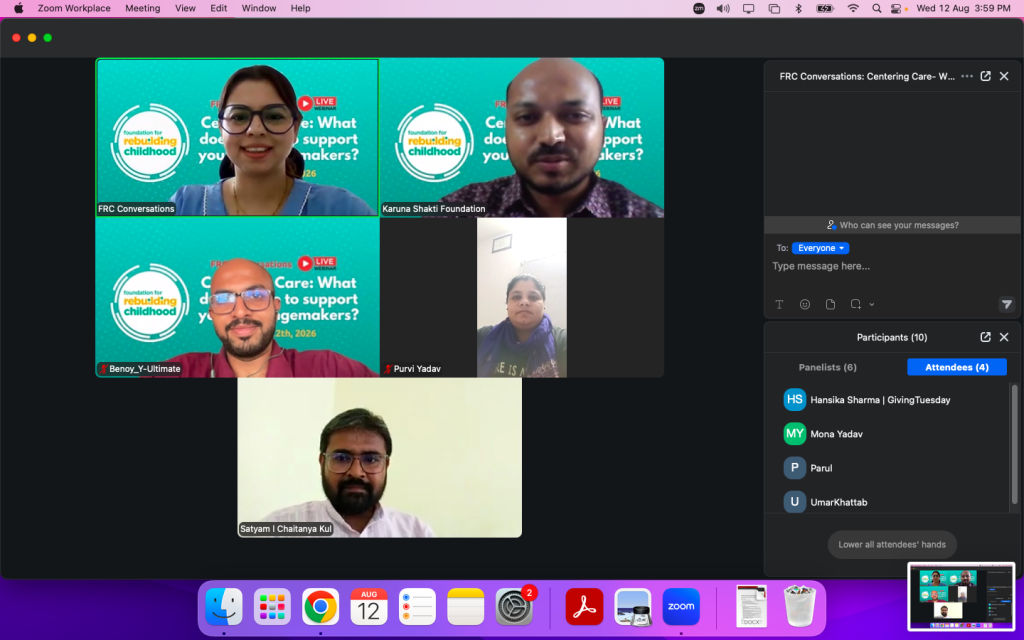
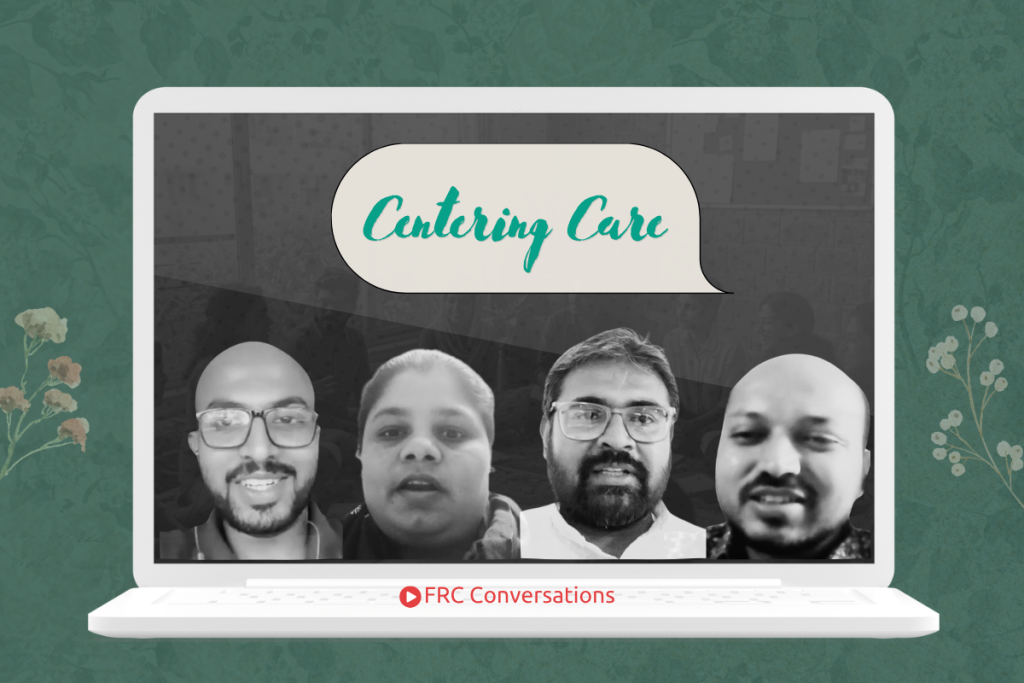
On International Youth Day, the Foundation for Rebuilding Childhood (FRC) launched its inaugural FRC Conversations webinar with four grassroots leaders: Benoy Stephen of Y-Ultimate, Satyam Shrivastav of Chaitanya Kul, Purvi Yadav of Sahas Foundation, and Himanshu of Karuna Shakti Foundation. The conversation explored what it means to support young changemakers and why care needs to be at the centre of that support.
FRC works with early-stage, mostly youth-led, community-based organisations across India, investing in capacity building, mentorship and, at times, flexible funding. The approach is rooted in a simple belief: grassroots and young leaders are often closest to the problems they are addressing. Supporting their capacity, not just their programmes, is essential to building organisations that can sustain their work and create lasting change for the future of the youth in India.
Young People Need More Than a Seat at the Table
The journeys of the four speakers were different, but each began with a question, an experience or a desire to create new possibilities for young people.
For Benoy, Y-Ultimate grew organically from a shared love for Ultimate Frisbee. Playing together led to conversations about education, aspirations and what young people could achieve. The organisation evolved into a space where young people could pursue their own goals while becoming changemakers themselves. For Benoy, social change takes time. Rather than constantly looking for immediate results, supporting young people means trusting the process and giving them opportunities to grow.
For Purvi, activism began in the aftermath of the 2012 Delhi gang rape protests. Experiences of victim-blaming and being in spaces where her voice was not heard eventually led her and her sister and co-founder Mona to start Sahas Foundation in 2016. Today, Sahas creates spaces where young people, particularly adolescent girls, can ask questions, challenge systems and learn to lead their own lives with courage.
Himanshu’s journey with Karuna Shakti Foundation grew out of years of working in child rights and child protection and recognising a gap in his region. He wanted to build an organisation rooted in a rights-based approach rather than simply a welfare model. The early journey was not easy, particularly when navigating registrations and compliances, but the practical and emotional support of his co-founder helped him continue.
For Satyam, the starting point was more personal: the need for safe spaces where he could express himself, make mistakes and discover his own answers. That experience shaped his work with children and young people and his belief that leadership is about creating the conditions in which young people can find and use their own voice.
These stories remind us that leadership does not always begin with a formal plan. Sometimes it begins with a question, an experience, a frustration or simply the belief that something can be different.
Participation Is Not the Same as Leadership
One of the strongest reflections from the conversation was that inviting young people to participate does not automatically mean giving them power.
Satyam described meaningful participation through three words: voice, choice and consequence. Young people need the ability to influence decisions, make choices and understand the consequences of those choices. Giving them responsibility without authority can turn leadership into labour rather than genuine participation.
This shifts the question from How do we engage young people? to How much power are we actually willing to share with them?
It means examining who defines the problem, who decides the solution, who controls resources and who gets to say no. As Satyam reflected, leadership is not about becoming the voice of young people. It is about creating the conditions in which they can find and use their own voice.
For Benoy, this means reaching a point where young people can genuinely say, “Hamara programme.” For Himanshu, it means providing support without taking over, with clear roles and healthy boundaries.
Care Has to Be More Than a Statement
The conversation also challenged the idea that care is simply about being supportive or emotionally available. Care can mean funding, flexibility, mentorship, time, listening and creating opportunities. It can also mean knowing when to step back.
Purvi challenged the tendency to measure commitment through exhaustion and romanticise resilience. Young leaders need opportunities to share responsibility, make mistakes and rest. This is particularly important when working with girls and women who are navigating structural inequalities shaped by patriarchy and misogyny. Care, therefore, cannot be gender-neutral.
At Sahas, centering care means building it into the organisation itself. This includes regular spaces for team members to talk about how they are feeling, mental health support, rest after difficult experiences and informal moments of connection, from sitting under a tree in a village to having chai together.
For Himanshu, care also means creating safe spaces for people who are themselves creating safe spaces for others.
This is where care becomes structural. If we expect young people to change systems while operating within systems that exhaust them, we risk reproducing the very inequalities we claim to challenge.
From Managing Young People to Trusting Them
Perhaps the clearest message from the conversation was the need to move from managing young people to trusting them.
Young changemakers need more than responsibility. They need resources, authority and room to grow without constantly having to prove their worth.
Care also means recognising that the person producing an outcome matters as much as the outcome itself. As Satyam put it, the outcome matters, but the human being producing the outcome matters equally.
This requires institutions, funders and mentors to think beyond short funding cycles and immediate programme indicators. It requires long-term relationships, flexible support and a willingness to invest in organisational capacity as much as programme delivery.
Sustaining the People Who Sustain Change
Ultimately, the conversation brought us back to a fundamental question: what happens to the people doing the work?
Young changemakers need rest, recovery and people they can ask for help. They need organisations that understand that taking a break is not a failure of commitment.
The inaugural FRC Conversations webinar left us with a powerful reminder: young people do not need to be constantly pushed to prove that they can lead. They need to be trusted, supported and given meaningful opportunities to shape the work that affects them.
The future of youth leadership depends not only on young people creating change, but on whether institutions, funders, mentors and leaders are willing to build conditions in which they can do so without sacrificing their wellbeing.
If we want lasting change, we need to centre care in the way we build, fund and lead.