What does it really mean to monitor a programme? How is monitoring different from evaluation? And how do you measure changes that are important but difficult to quantify, such as a child’s confidence, participation or engagement?
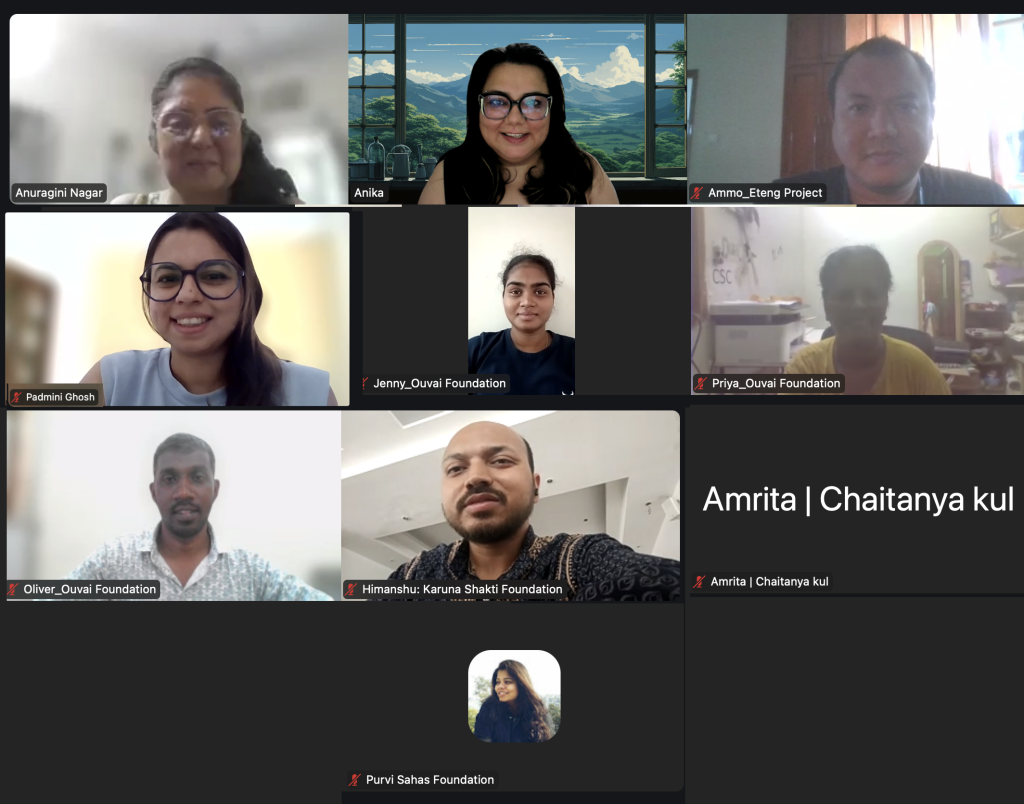
These were some of the questions that emerged during a recent session on Monitoring, Evaluation and Learning (MEL) with grassroots organisations, held as part of our Community Connect 2026 capacity-building series.
The session was expertly led by Anuragini Nagar, a sector veteran with extensive experience across the development and corporate sectors, spanning programme strategy and design, operational planning, budgeting, partnerships, M&E, RBM and multi-donor, multi-state programme delivery. She specialises in building efficient systems and innovative, scalable solutions, drawing on her experience in behaviour change communication, programme learning, reporting and cross-functional collaboration.
Rather than treating M&E as a fixed set of tools or processes, she designed the session as a space for participants to examine how they currently monitor their programmes, where they face challenges, and what a practical monitoring framework could look like.
Starting with different understandings
The conversation began with a simple question: What does monitoring and evaluation mean to you?
Participants described M&E in different ways, including tracking activities, measuring impact, assessing the effectiveness of interventions and identifying areas for improvement. This itself highlighted an important point: organisations may use the language of M&E regularly, while having different understandings of what it involves.
Anuragini helped distinguish three connected but different processes:
- Monitoring focuses on whether planned activities are being implemented as intended.
- Evaluation looks at what those activities are achieving and whether they are contributing to the intended outcomes.
- Learning involves reflecting on what has been observed and using those insights to improve programmes.
But the distinction is not always straightforward. Participants also raised questions about where monitoring ends and evaluation begins, particularly when assessing the quality of an activity rather than simply whether it took place.
The challenge of measuring qualitative change
One of the most difficult questions was how to measure changes that cannot easily be reduced to numbers. A participant raised the example of a child whose confidence grows, reflected in greater classroom participation, interaction or willingness to volunteer. How should such change be captured?
The discussion highlighted that qualitative outcomes do not necessarily need to become numbers. Instead, organisations need to define what the desired change looks like and identify observable indicators that provide evidence of it.
Indicators must also reflect the programme’s purpose. If a programme aims to bring school dropouts back into education, tracking overall attendance alone may not tell us whether it is reaching the intended children. The starting point is therefore not “What can we measure?” but “What are we trying to achieve, and what would tell us we are moving towards it?”
Building from existing processes
The group explored four aspects of a monitoring framework: tools, processes, indicators and case studies. Participants already used approaches including in-person visits, phone follow-ups, group observations, digital applications and written documentation. While organisations had resources to draw on, time was a significant constraint, making it important to develop systems that are realistic.
Rather than measuring everything, the group discussed identifying around ten critical indicators, breaking them into manageable components and using methods such as self-assessment, facilitator observations and team visits. The emphasis was on building the system gradually rather than creating a perfect framework from the start.
Starting with the basics, the exercises demonstrated the value of simple indicators such as enrollment, participation and location in understanding who a programme is reaching and how consistently.
The conversation then explored what engagement actually means. For another participant, it could include actively participating in activities, such as playing frisbee and following the rules. Others tracked engagement through digital applications, worksheets and art activities.
Teacher and facilitator engagement could also be included, depending on the programme. This reinforced the need for a framework that provides structure while remaining adaptable to different programme contexts.
Did the activity happen, and did it happen as intended? The group also explored this important distinction in monitoring educational activities. For example: if a teacher is expected to conduct a picture-description activity, monitoring should establish not only whether it happened, but whether the facilitator was prepared, instructions were clear, the activity followed the intended approach and children were engaged.
Monitoring, therefore, is not simply about checking whether an activity happened. It can also help organisations understand how implementation is taking place and where facilitators may need additional support.
Looking beyond success stories
The discussion on case studies highlighted the importance of documenting what led to a change, what challenges emerged and what contributed to the outcome, rather than simply recording positive results.
Our moderator emphasised continuously documenting highlights, challenges and successes. For example, high participation in parent-teacher meetings may be a programme highlight, but can also reveal challenges for parents balancing work and school responsibilities.
This is where learning becomes critical. A positive result does not mean there are no challenges; sometimes, the challenges revealed by a success are just as valuable for programme learning.
Measuring what matters
The discussion reinforced that for grassroots organisations, M&E should be useful, realistic and connected to the work on the ground, rather than focused on collecting data for its own sake. Starting with clear objectives, relevant indicators and simple tools can help organisations understand what is working, recognise change and continuously improve.
This approach closely reflects FRC’s mission to strengthen emerging community-based organisations with the knowledge, resources and support they need to create lasting change for children and young people. Ultimately, the question is not, “How much did we measure?” but, “What did we learn, and how can we use that learning to do better?” This is precisely what we aim to foster through our Community Connect workshop series.