Education is so much more than academic learning. It shapes how children understand themselves, relate to others, negotiate differences and engage with the world around them. It also plays a significant role in reinforcing, questioning or challenging the gender norms and power structures that shape our everyday lives.
We believe that reimagining education means looking beyond textbooks and classrooms to recognise the social, cultural and lived realities that influence a child’s holistic development. This includes creating learning environments where children and young people can explore their identities, exercise agency and grow without being restricted by gender stereotypes.
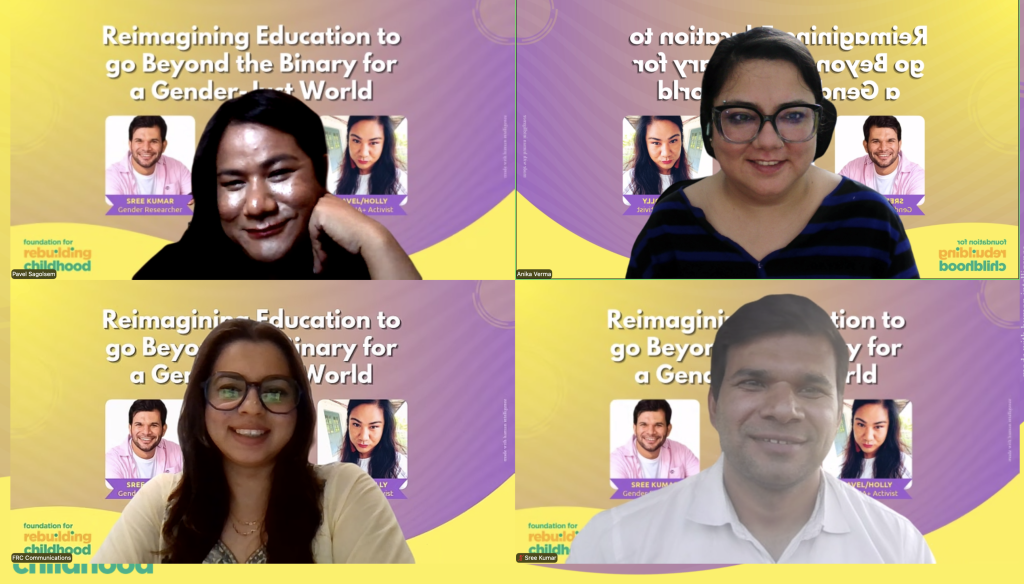
In the second session of FRC Conversations, held on 19 November 2026, coinciding with International Men’s Day and Trans Awareness Week, we explored how education, both formal and informal, can contribute to building a gender-just world. The conversation featured gender justice practitioners Sree Kumar (he/him) and Holly/Pavel Sagolsem (she/they), who brought together their professional insights and lived experiences to examine masculinity, gender, power and choice.
Understanding masculinity, gender and power
Gender is so deeply embedded in our everyday lives that we often stop noticing how it shapes our behaviour and expectations. As Sree pointed out, understanding gender socialisation is about learning to recognise how power operates around us, including in our families, communities and institutions.
Society assigns different roles, expectations and privileges based on perceived biological differences. These socially constructed expectations influence how people are expected to behave, express themselves and relate to others. Masculinity, for instance, is often associated with control, authority, emotional restraint and dominance.
However, these ideas are neither universal nor fixed. Sree distinguished between aggressive or toxic expressions of masculinity and healthy masculinity, which challenges inherent inequalities and oppression. He drew on the film Mohabbatein to illustrate this contrast: while Amitabh Bachchan’s character represents a more rigid, stoic and controlling version of masculinity, Shah Rukh Khan’s character demonstrates vulnerability, emotional expression and a willingness to question established norms.
Pavel expanded the conversation by challenging the assumption that gender cannot be understood through a simple male-female binary. Bodies, biological characteristics, gender identities, expressions and sexual orientations are diverse. Not every man or woman fits conventional expectations, and not everyone’s desires or identities follow heterosexual norms.
Gender, therefore, cannot be reduced to two fixed categories. It is fluid, shaped by individual experiences, social contexts and changing cultural realities. At its heart, understanding gender is also about recognising agency and choice: the freedom to decide how we express ourselves, how we wish to be seen and which norms we choose to question or challenge.
How education reinforces gender norms
If gender norms are socially learned, education has an important role in determining how they are understood and reinforced.
As Sree highlighted, schools do not only teach through their formal curriculum. They also have a hidden curriculum made up of everyday practices, behavioural expectations and institutional rules. From separate seating arrangements and gender-specific dress codes to how teachers respond differently to boys and girls, these practices communicate what is considered acceptable behaviour.
Peer culture also plays a role. Harmful attitudes towards girls, objectification and disrespect are sometimes dismissed as “boys simply being boys”. Such responses normalise behaviour rather than encouraging children to reflect on consent, equality and mutual respect.
The limited engagement with sexuality in school education further compounds the problem. Discussions are often reduced to biological processes, with menstruation receiving attention in the context of girls and sexuality being treated as a sensitive or uncomfortable subject. This leaves children and adolescents with little space to ask questions, understand their bodies or develop healthy attitudes towards relationships.
Pavel added another dimension to this discussion: when children are expected to constantly conform to social expectations, they gradually learn to measure their worth through external approval rather than their own sense of self. When conformity is rewarded and difference is discouraged, children may begin to see other people’s choices as a threat rather than something to respect.
Instead of nurturing confidence and individuality, such environments can reinforce competition, insecurity and the need for validation. This is where the need to reimagine an ecosystem where children’s uniqueness is encouraged instead of forcing them all into pre-set notions.
Inclusion must go beyond token representation
Transgender and gender-diverse inclusion is often treated as a separate conversation, rather than an integral part of gender equality. Pavel highlighted how gender discussions in India frequently revolve around family structures, reproduction and conventional ideas of masculinity and femininity. This can make it difficult for children and young people to understand or express identities that fall outside these expectations.
She also drew attention to the role of shame and fear. A child who feels different may hesitate to express themselves because they have witnessed how society treats people who do not conform. Even supportive parents may worry about the bullying or discrimination their child could face at school.
She shared an example from a school in Moirang, Manipur, where a transgender child did not want to attend school because they were being forced to wear trousers. Rather than approaching the issue only through demands for policy change, transgender activists initiated conversations with the school principal, parents and students. Through dialogue and collective decision-making, the school agreed to allow the child to wear a skirt.
This example demonstrates how inclusion can become meaningful through listening, understanding individual circumstances and building consensus. It also reminds us that inclusion is not simply about accommodating someone who is seen as different. It is about questioning the systems and practices that make certain children feel they do not belong in the first place.
From conformity to compassion and affirmation
What would it take to create educational spaces where children can develop a sense of self while learning to respect others?
Both speakers emphasised the importance of listening. Sree suggested moving away from education that focuses exclusively on constant activity, instruction and measurable outcomes, towards creating intentional spaces for reflection and dialogue. Teachers can play a more facilitative role, helping children recognise patterns, question assumptions and express their thoughts. After all, the work of educational ecosystems is to guide children into becoming thoughtful individuals and not products.
Schools can also encourage student-led groups, discussions and collective activities where children learn to raise questions, engage with differences and participate in decision-making.
Pavel proposed shifting the emphasis from social expectations to social awareness, and from reward and punishment to affirmation. A young person’s ability to express their gender identity or nonconformity depends largely on whether they feel safe doing so. When children see others being punished for being different, they internalise shame and fear, often making it difficult to express themselves even at home, let alone in school.
This shame can extend to parents too. Even those who affirm their child’s identity at home may hesitate to support their gender expression outside it, fearing social judgement or that their child might face greater bullying and backlash.
Breaking this cycle means moving away from telling children how they should behave towards creating spaces where they can express themselves without shame or fear. Adults must learn to listen, understand their preferences and affirm their identities rather than correct or punish what makes them different.
This does not mean removing boundaries or guidance. It means recognising children as individuals with evolving identities, perspectives and agency. Providing choices, encouraging reasoning and allowing room for exploration can help children develop confidence without depending entirely on external approval.
Importantly, these practices must extend beyond classrooms. Children learn from what they observe in their homes and communities. Sree emphasised the importance of adult role models, particularly men in families and schools, who demonstrate that masculinity need not be defined by control or authority. Sharing domestic responsibilities, caring for younger family members, expressing emotions and making space for others are everyday ways of modelling healthy masculinity.
As Pavel pointed out, it is equally important to examine how boys and girls are treated differently within the home. Are boys given greater privileges? Are their expressions of anger taken more seriously than girls’ quieter forms of protest? Building gender equality requires us to question these everyday patterns, not just the behaviour we expect children to display in public. Pavel also suggested bringing play and exploration into education, helping children understand that they have choices and that making different choices does not diminish someone else’s.
During the audience discussion, she further distinguished between teaching and coaching. Instead of simply telling children what to do, adults can ask questions, understand their preferences and help them reason through their decisions. Even small changes, such as offering children different ways to approach an assignment, can make learning more participatory and affirm their agency.
Reimagining education begins with us
A gender-just world cannot be built by asking children to fit into existing structures while expecting them to challenge the inequalities those structures reproduce.
Reimagining education requires us to move beyond rigid binaries, create spaces for informed choices and recognise the dignity of every child’s identity and lived experience. It means nurturing empathy, care, critical thinking and the confidence to question unfair norms.
As Pavel reminded young people during the conversation, we can make different choices at different points in our lives. What matters is learning to reason through those choices, understand what informs them and recognise how power operates in the world around us.
Ultimately, children need more than lessons about equality. They need to experience it in their classrooms, homes, relationships and communities. When listening replaces judgement, compassion replaces conformity and affirmation replaces shame, we create the conditions for every child and young person to learn, grow and thrive with dignity.
At FRC, we believe that education must equip children and young people not merely to fit into the world as it exists, but to have the agency, knowledge and imagination to shape a more equitable world for themselves and others.
Join us for the next edition of FRC Conversations! Follow us on Instagram and LinkedIn for updates and announcements.